Japandi Bedroom Ideas for Small Apartments
Apartment bedrooms come with problems a house does not have: no separate room, a lease that forbids drilling, a window facing a lit street and nowhere for the vacuum to go. Japandi handles all of them well, because it prefers freestanding pieces, soft partitions and storage that hides in plain sight.
These ideas are specifically for studios, one-bedrooms with tiny bedrooms and rentals where every change has to be reversible.
Idea 1: Zone the bed instead of walling it off
In a studio, mark the sleeping area with something low or soft. A folding wooden screen, a linen curtain on a ceiling track or tension rod, or a low bookshelf used as a half wall all suggest a room without cutting off light. A rug that begins where the sleeping zone begins does the same job with nothing vertical at all.
Keep the divider in the same palette as the rest of the apartment so it reads as furniture, not a wall.
Screen or curtain? A folding screen is best when you want to hide the bed from the sofa or the front door: choose one well above mattress height, around 5.5 feet (170 cm), and long enough to cover the side of the bed you see first. A curtain is best when the bed sits in an alcove or a corner. A floor-to-ceiling tension frame spans the opening without drilling, and a curtain about one and a half to two times the width of the opening falls in soft folds instead of hanging flat. Use the same linen curtains as the windows so the divider disappears into the room.
Idea 2: Put the bed where the door cannot see it
If the front door opens onto the studio, position the bed so it is the last thing visible from the entry: behind the screen, around the kitchen corner or on the far side of the sofa. Being able to walk in without seeing the bed makes a small apartment feel like it has rooms.
Idea 3: Let the bed be the storage
A platform bed with drawers or a lift-up base holds bedding, off-season clothes and luggage. That is often the entire storage problem of a small apartment solved in one piece. Choose a frame with plain wood fronts and no hardware so the drawers disappear. If your bed has no storage, use flat lidded boxes in a single color and a bed skirt in linen.
Idea 4: Use rental-friendly lighting
Overhead apartment fixtures are almost always bright and cool. Instead of replacing them, leave them off. Add a plug-in wall sconce with a linen shade beside the bed using a small mounting screw or a removable hook rated for the weight, a paper table lamp on the nightstand and a floor lamp in the corner. Warm bulbs, 2700K, in all of them.
Idea 5: Choose furniture that does two jobs
Every piece in a small apartment should earn its floor space:
- A wooden stool that is a nightstand, a step and extra seating.
- A rolling cart that is a nightstand by night and a plant stand or bar by day.
- A bench at the foot of the bed that holds clothes and doubles as a sofa for one.
- A low dresser that is also the TV stand or the desk.
Skip anything with only one use, such as a decorative chair no one sits in.
Idea 6: Block the city, keep the light
Apartment bedrooms are often bright at night from streetlights and neighbors. Layer sheer linen for daytime privacy with a blackout-lined linen curtain for sleep. Hang both from a tension rod or a track with adhesive mounts if the lease forbids drilling. Choose the same warm neutral for both layers so the window looks like one soft surface.
Idea 7: Keep the floor and the walls almost empty
In a small apartment, visual quiet is space. Store shoes in a closed box, hang bags on a single wooden peg, keep only a rug and the furniture on the floor. On the walls, one piece of art leaned on a shelf or hung with picture strips. The less there is to look at, the larger the apartment reads.
Idea 8: A drop-leaf table instead of a dining table
A studio rarely has room for a dining table that stays open all day. A drop-leaf table solves it: with the leaves down it stands against the wall as a narrow console that holds a lamp and one bowl, and with the leaves up it seats two for dinner. Choose wood in the same tone as the bed and shelves so it reads as part of the room rather than a second piece of kitchen furniture.
Keep two stools or folding chairs nearby that tuck under the table or hang on a wooden peg. Backless stools work best: a seat height of about 17 to 18 inches (43 to 46 cm) suits a standard 29 to 30 inch (74 to 76 cm) table, and with no back they slide fully under the leaves. Before buying, check that the stools fit between the table legs with the leaves down. Clear the top back to one object after every meal; a drop-leaf table only works as a console when it looks like one.
That one object is usually a lamp, and a cordless, rechargeable one suits a drop-leaf table best: when you pull the table out for dinner, there is no cable stretched from the outlet across the floor you just opened up. Look for a narrow lamp with a solid-wood base and a linen shade. One about 3 inches (8 cm) wide, 10 inches (25 cm) deep and 14 inches (35 cm) tall stands on the fixed center top without crowding it, but measure your table’s center before buying. At dinner, dim it and leave it in the middle as table light, or move it to a shelf to make room for two plates. Charge it during the day; a lamp like this runs about 6 to 8 hours on a charge.
If the studio has no cupboard space left, choose a drop-leaf table that stores things too. Some fold down to a console only about 13 inches (33 cm) deep, with two small drawers for cutlery and napkins and an open shelf underneath, and roll on locking wheels so you can pull the table away from the wall before opening the leaves. Keep the shelf to two or three lidded boxes or baskets in one color so the table still reads as calm, and check before buying that your stools fit under the leaves, since a bottom shelf can block them.
If even a narrow drop-leaf table takes too much floor, move the table onto the wall. A solid-wood wall-mounted folding table about 16 inches wide and 24 inches deep (40 x 60 cm) opens into a breakfast spot for one, enough for a plate, a cup and a laptop, and folds to about 3 inches (8 cm) against the wall when you need the floor back. Mount the top at table height, around 29 to 30 inches (74 to 76 cm), beside the window or under a shelf, and screw the bracket into a stud rather than drywall anchors alone. If you rent, ask before drilling. Keep one backless stool for it and slide the stool underneath when the table is folded.
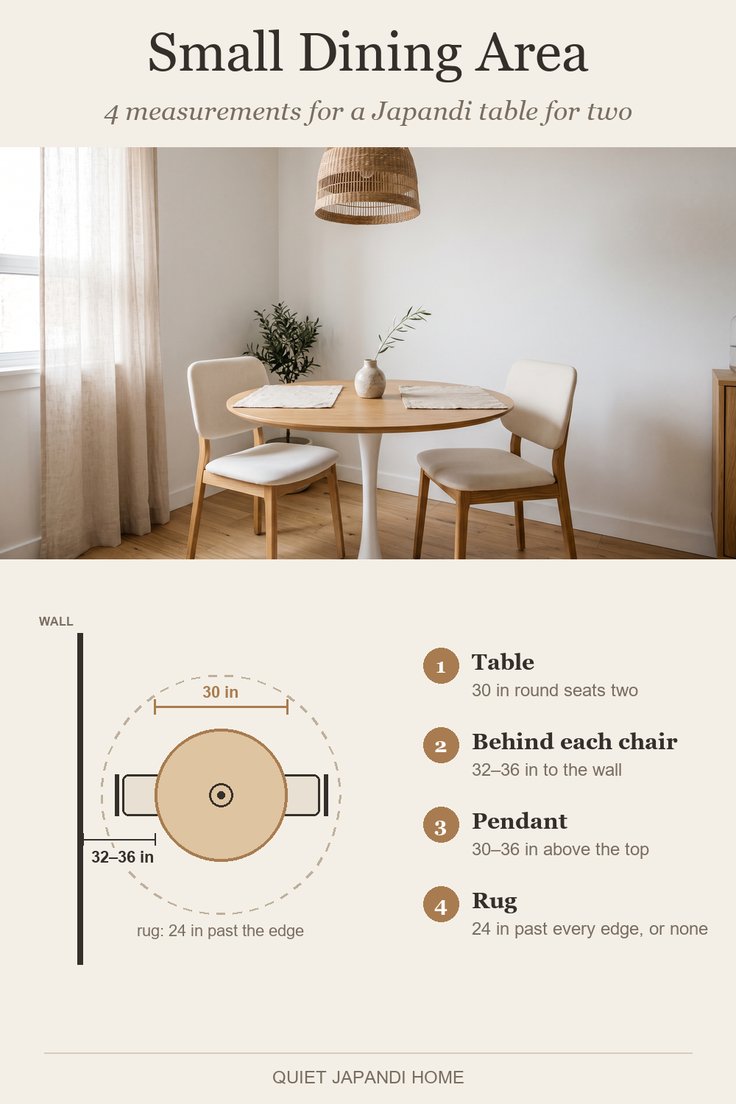
If you do have a corner where a small table can stay open, see Small Dining Area Ideas for a Japandi Apartment for the table size, the space to leave behind each chair and how low to hang the light.
Idea 9: A slim work cart that rolls out of sight
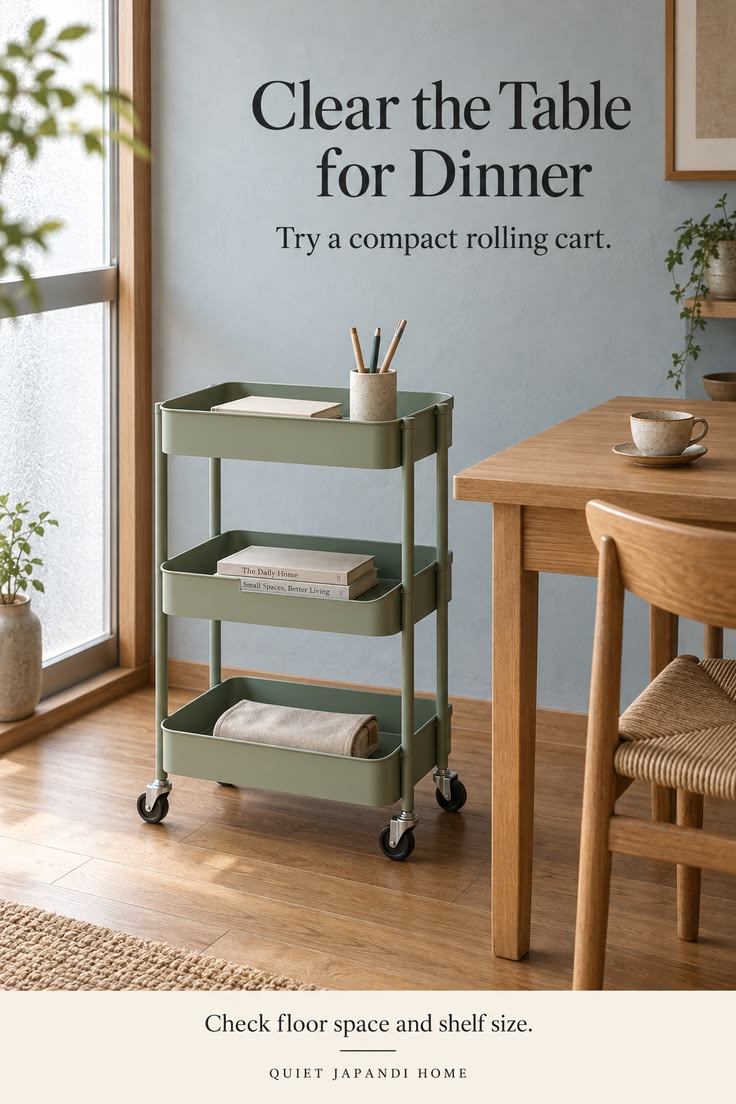
When the table is also the desk, work spreads: a laptop charger, a notebook, pens, a stack of paper. By evening the dining table looks like an office, and in a studio that office is in your bedroom. Give the work things their own place on wheels. Put the charger and the things you use every day in the top basket, notebooks and pens in the next, and paperwork at the bottom.
In the morning, roll the cart next to the table. At the end of the day, put everything back in it and roll it into a narrow gap, beside the wardrobe, next to the bed or against the wall behind a screen. A slim cart about 6 inches (16 cm) deep fits gaps a normal cart cannot; measure the gap and check the height if it has to sit under a window. Choose dark metal and a wood top that match the room, and keep the top clear so it reads as furniture, not storage.
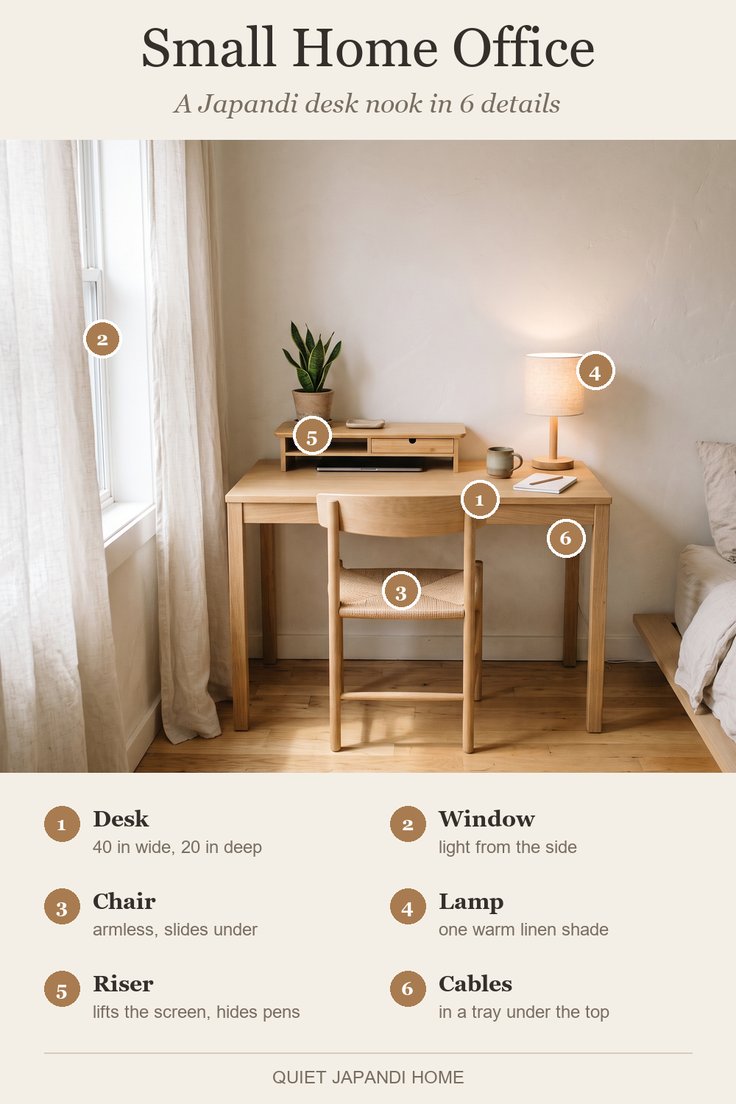
If you work at home most days and have a corner to spare, a small desk of its own works better than a cart; see Small Home Office Ideas: A Japandi Desk Nook for the desk size, where to put it and how to hide the cables.
How to Get the Look
- Decide the sleeping zone and mark it with a screen, curtain or rug.
- Angle the bed out of the entry sightline.
- Choose a storage bed or add matching under-bed boxes.
- Turn off the overhead light; add a plug-in sconce, a table lamp and a floor lamp.
- Replace single-use furniture with a stool, a cart and a bench.
- Layer sheer and blackout linen on a no-drill rod.
- Clear the floor and limit the wall to one piece.
- Use a drop-leaf table as a console by day and a dining table at night.
Recommended Items
A few pieces that carry this look. Each link opens Amazon in a new tab, so you can compare sizes, colors and reviews.
Folding Bamboo Room Divider Screen
Why it works: Creates a sleeping zone in a studio without any installation, and folds flat against the wall when you want the space open.
View on AmazonNo-Drill Floor-to-Ceiling Tension Rod Room Divider (Curtain Not Included)
Why it works: A tension frame that stands between floor and ceiling and adjusts from 28 to 114 inches wide, so a renter can hang a linen curtain across a bed alcove without drilling.
View on AmazonLow Oak Platform Bed with Two Storage Drawers
Why it works: A floor-level wood frame in an oak finish with two drawers for linens and off-season clothes, so the largest object in the apartment also becomes its largest storage unit. Sold from twin to California king.
View on AmazonLinen-Blend Rod Pocket Curtain
Why it works: Slides onto a tension rod, so it softens a window or divides a corner without drilling, which most leases require.
View on AmazonSlim Rolling Cart in Wood and Metal
Why it works: Works as a nightstand, a bedside shelf and a bar or plant stand; moves wherever the day needs it.
View on AmazonWood Drop-Leaf Dining Table
Why it works: Stands against the wall as a narrow console during the day and opens into a table for two at dinner, so a studio does not have to give up floor space to a dining table.
View on AmazonBackless Wood Saddle Stools, Set of 2
Why it works: Backless stools with a 17.5-inch seat suit a standard-height table and slide fully under the leaves, so the table still reads as a slim console when it is folded.
View on AmazonSolid Wood Wall-Mounted Folding Table, 15.7 x 23.6 Inches
Why it works: A natural solid-wood top that folds down flat to about 3 inches against the wall; open, it gives one person a breakfast or laptop spot in a studio with no floor left for a drop-leaf table.
View on AmazonSolid Wood Cordless Table Lamp with Linen Shade (Rechargeable)
Why it works: A solid-wood lamp with a linen shade and no cable, about 3 inches wide, so it fits the narrow top of a folded drop-leaf table and moves aside at dinner without a cord across the floor.
View on AmazonDrop-Leaf Table with Two Drawers, a Shelf and Locking Wheels (Folds to 13 Inches Deep)
Why it works: Folded, it is a 13-inch-deep console with two drawers and an open shelf; opened, it is about 60 by 31.5 inches, so one piece holds the cutlery and becomes the dining table in a studio with no cupboard space left.
View on AmazonSlim 4-Tier Rolling Cart with Wood Top (6.3 Inches Deep)
Why it works: At about 6 inches deep it slides into the gap beside a wardrobe or the wall, and its pull-out baskets keep chargers, notebooks and pens together so the table can go back to being a table after work.
View on AmazonAs an Amazon Associate, Quiet Japandi Home earns from qualifying purchases. This does not change the price you pay. Read our disclosure.
FAQ
How do I separate the bed in a studio apartment?
Use something you can see over or move: a folding screen, a linen curtain on a ceiling track or tension rod, a low open bookshelf or simply a rug that stops where the sleeping area begins. Full-height solid dividers make a studio feel like two closets.
What Japandi changes are allowed in a rental?
Almost all of them. Plug-in sconces, tension-rod curtains, removable hooks, freestanding screens, rugs and bedding need no drilling. If you want art on the wall, use picture-hanging strips rated for the weight or lean it on a shelf.
Where does clothing storage go in a small apartment bedroom?
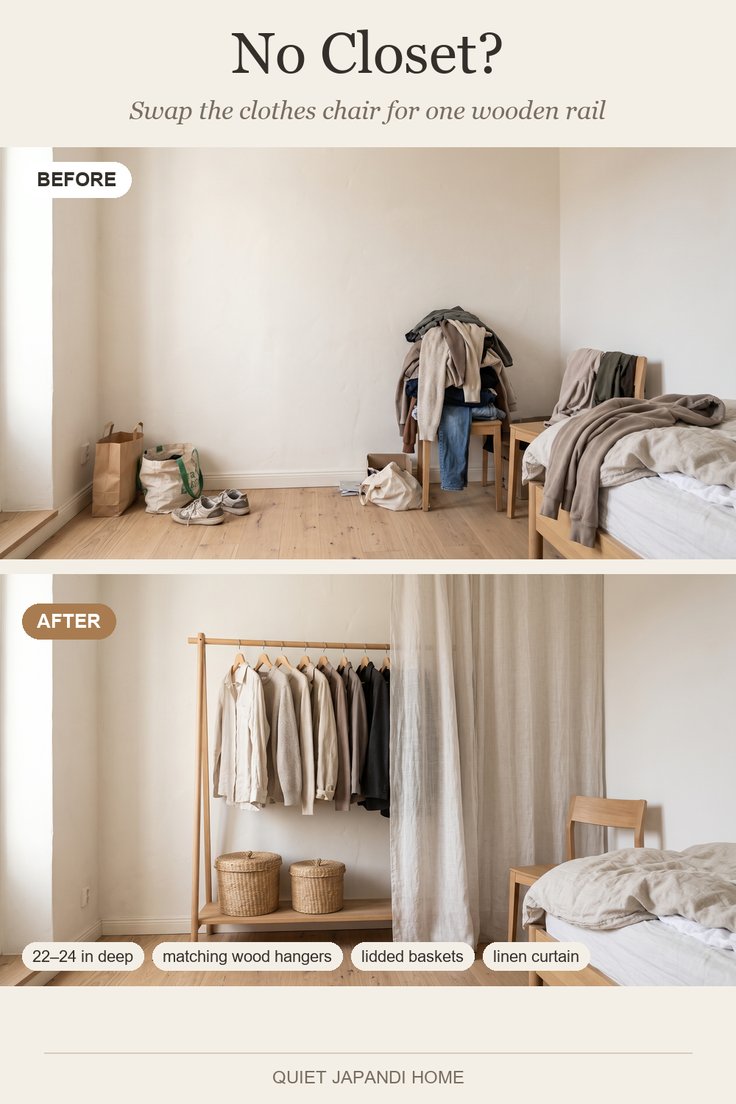
Under the bed first, then a single closed wardrobe or a garment rail with a linen cover. Keep the visible rail short: only the clothes for this season, in neutral colors, so it reads as part of the room rather than a closet.