Japandi Bedding Ideas for a Minimalist Bedroom
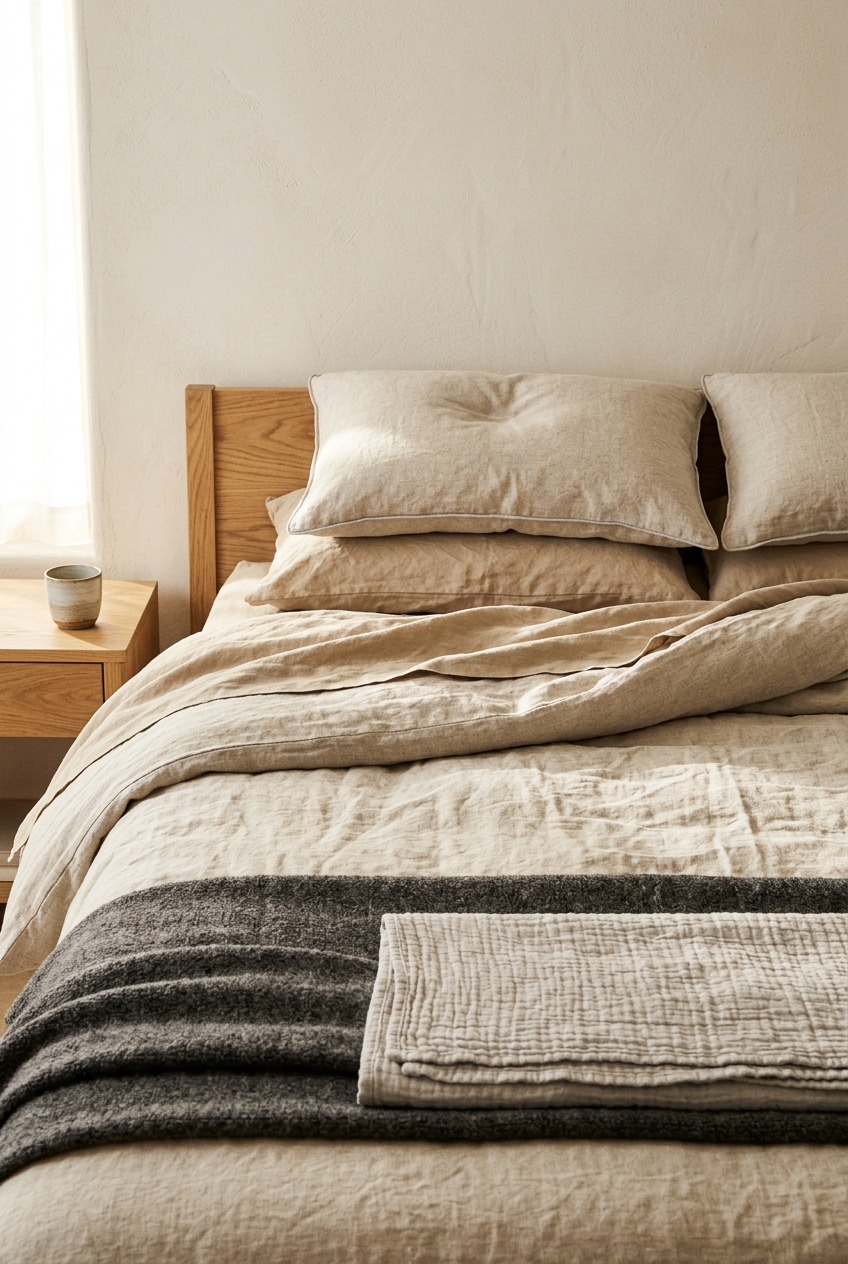
The bed is the largest surface in the bedroom and the one you touch every day, so bedding does more for a Japandi room than any decoration. The formula is short: natural fibers, warm neutrals, two pillows, one throw, one fold. The rest is choosing the right shades and textures for your room.
Idea 1: Start with washed linen
Linen is the default Japandi bedding for a reason. It has a matte surface, a visible weave and a slightly rumpled drape that looks relaxed without looking unmade. Choose stonewashed or garment-washed linen; unwashed linen is stiff for the first year. Weights around 165 to 190 gsm suit most climates.
If linen is too rough or too expensive, a cotton-linen blend or a washed cotton gauze gives a similar texture.
Idea 2: Keep to warm neutrals, one or two shades
The bed should be a shade or two deeper than the wall so it reads as a soft shape. Oatmeal, sand, flax, warm stone and soft clay all work. Use one color for the duvet and a slightly different one for the sheets and pillowcases, such as oatmeal over sand, so there is depth without contrast. Bright white sheets against warm walls make the walls look dingy.
Idea 3: Two pillows, no shams
A Japandi bed has the pillows you sleep on and nothing else: two for a double or larger, one for a single. No decorative shams, no stacked euros, no bolster. If the bed feels bare, a single small cushion in sage, clay or indigo, or in a contrasting texture such as wool or boucle, is the most you should add.
Idea 4: One throw, folded at the foot
A throw in a deeper neutral, folded in thirds and laid across the foot of the bed, is the one styling move a Japandi bed needs. Wool, cotton waffle or a heavy linen all work. Charcoal, walnut brown or a dark olive gives the pale bed its anchor. Avoid draping it diagonally; the straight fold is the point.
Idea 5: Add a quilt or futon-style layer
For a more Japanese feel, replace the thick duvet with a thin cotton quilt or a folded futon-style topper laid flat over the sheets. Cotton gauze quilts, sashiko-stitched covers and simple kantha quilts in a single muted color add a quiet grid of texture. In winter, layer the quilt over the duvet rather than adding a second comforter. If you cannot find a quilt you like, a layered cotton muslin blanket gives a similar light, crinkled look.
Idea 6: Match the pillowcases to the duvet, not the sheets
A small detail that makes the bed look composed: pillowcases in the same fabric and color as the duvet cover, with the fitted sheet and any top sheet in the second shade. The bed then reads as two clean layers, top and bottom, instead of a mix. Separate brands rarely match exactly, so aim for a similar warm undertone rather than an identical shade. Plain envelope-style cases keep the edges simple. Measure your pillows before choosing a size; the natural-linen pair linked below is 20 x 26 inches. If your duvet set already includes suitable pillowcases, use those instead of buying another pair.
Idea 7: Make the bed the same way every day
The Japandi bed looks calm because it is made deliberately. Smooth the bottom sheet. Pull the duvet up to the pillows, then fold the top third back once. Plump the pillows and lay them flat, not propped. Fold the throw and lay it across the foot. Ninety seconds, every morning, and the whole room looks finished.
How to Get the Look
- Buy a stonewashed linen or cotton-linen duvet cover in a warm neutral.
- Choose sheets one shade lighter or deeper; avoid bright white.
- Use two sleeping pillows in cases that match the duvet.
- Add one throw in a dark neutral, folded in thirds at the foot.
- Optional: a cotton quilt or futon-style topper for a more Japanese feel.
- Make the bed with one fold every morning.
Recommended Items
A few pieces that carry this look. Each link opens Amazon in a new tab, so you can compare sizes, colors and reviews.
Washed Linen Duvet Cover Set in Natural Flax, 3 Pieces
Why it works: 100% washed linen, so it drapes and creases gently instead of looking stiff. The set includes two pillow shams in the same fabric, which also covers Idea 6. Choose your size on the Amazon page.
View on AmazonTUMEI 100% Linen Pillowcases, Set of Two, Natural Linen, 20 x 26 Inches
Why it works: Plain natural-linen cases with an envelope closure keep the pillow layer simple. This pair is 100% linen and measures 20 x 26 inches; check your pillow dimensions before ordering. Choose a duvet in a similar warm neutral for a tonal look.
View on AmazonOrganic Cotton Muslin Blanket, 90 x 90 Inches, Oatmeal Khaki
Why it works: A pre-washed, plant-dyed gauze blanket in queen size. It is not stitched like a quilt, but it gives the same light, crinkled layer without the bulk of a comforter.
View on AmazonWool Blanket in Charcoal, Twin Size
Why it works: The one dark element on a pale bed; folded at the foot it anchors the whole composition. This thick, plain blanket is 80% wool and measures 64 x 88 inches, so it folds easily into thirds.
View on AmazonAs an Amazon Associate, Quiet Japandi Home earns from qualifying purchases. This does not change the price you pay. Read our disclosure.
FAQ
Is linen or cotton better for Japandi bedding?
Linen is the classic choice because of its matte, textured look and how it drapes. Good alternatives are a cotton-linen blend, cotton gauze or a washed cotton percale in a warm neutral. Avoid sateen and anything with sheen.
How many pillows should be on a Japandi bed?
Two sleeping pillows for a double or larger bed, one for a single. Skip decorative shams and stacks. If you want one accent, use a single small cushion in a muted color or a different texture.
How do I make a linen bed look neat instead of messy?
Smooth the bottom sheet, pull the duvet up, then fold the top third back once toward the foot. Fold the throw in thirds lengthwise and lay it across the foot. The single deliberate fold is what separates relaxed from unmade.