7 Small Japandi Bedroom Ideas for a Calm and Cozy Space
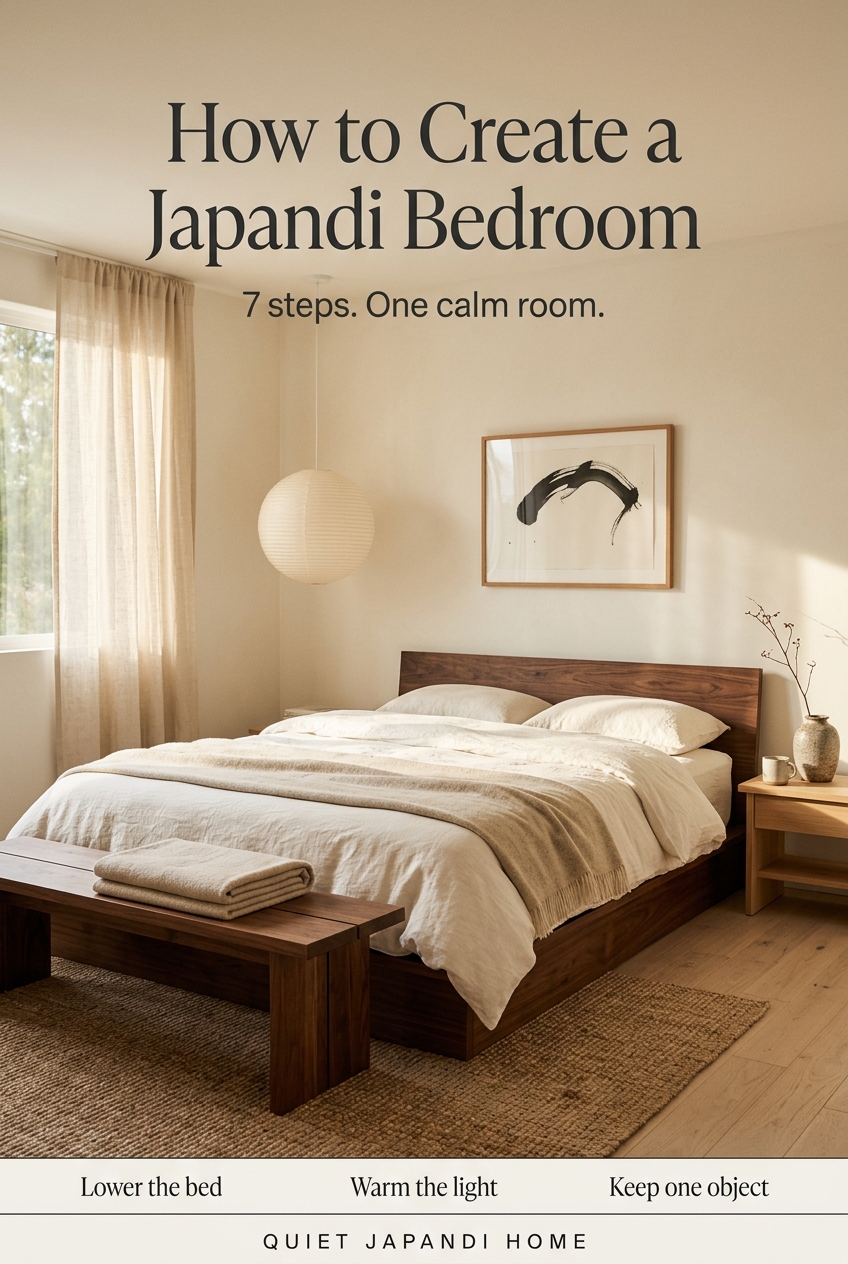
A small bedroom is actually where Japandi works best. The style is built on restraint: a few well-made pieces, natural materials and a lot of quiet space around them. In a compact room you cannot fit much anyway, so the limits of the room and the rules of the style point in the same direction.
These seven ideas focus on the decisions that change how a small room feels: how low the furniture sits, how many materials you use, where the light comes from and what stays visible.
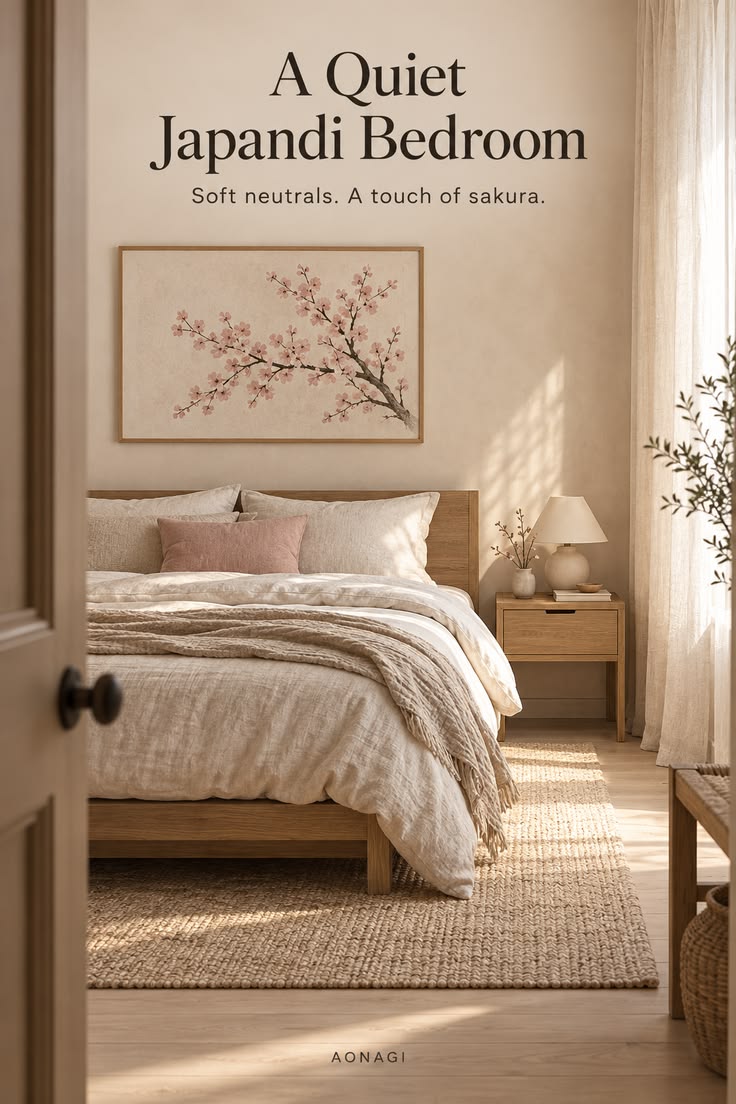
Here for the sakura print above the bed? Idea 7 covers the frame size, the mat, how high to hang it and which hooks to use.
Idea 1: Choose a low platform bed
The bed is the largest object in the room, so its height sets the mood. A platform bed that sits 10 to 14 inches (25 to 35 cm) off the floor, with no footboard and a short or absent headboard, lowers the whole room’s center of gravity. Your eye reads more wall above the bed, and the ceiling feels higher than it is.
If you already own a taller bed, remove the headboard and swap tall legs for short ones. The change costs almost nothing and does most of the work.
The frame we link goes lower still: 7.7 inches (20 cm) tall, resting directly on the floor, with a slat base that needs no box spring. It is engineered wood in a pine tone rather than solid oak, so it is a budget way to get the shape, not an heirloom. Because it sits on the floor there is no room underneath, so with this frame the flat storage boxes in Idea 5 have to go somewhere else.
Idea 2: Stick to one wood tone
Small rooms get busy fast. Pick one wood tone for the bed, nightstand and any shelf, and keep it in the light-to-medium range: white oak, ash or light walnut. Matching tones let separate pieces read as one calm group instead of three competing objects.
If mixing is unavoidable, keep the second wood to something small and clearly different, such as a dark walnut tray on a light oak nightstand, so it looks intentional.
The tray is the easiest way to do it, because it is small and you can move it. A solid walnut tray about 12 by 5 inches (30 x 13 cm) fits on most nightstands beside the lamp, holds a watch, glasses and your phone overnight, and keeps them off the oak top. Let it be the only dark wood in the room. If you add a second dark piece later, choose the same walnut so the two read as a pair rather than a third tone.
Idea 3: Keep the palette to three neutrals
Use a warm white on the walls, a soft oatmeal or sand for the bedding and one deeper anchor such as charcoal or mushroom brown in a throw or a lamp base. Three tones is enough to create depth; more starts to look like a color scheme rather than a calm room.
Avoid pure bright white. It reads cold next to wood and linen. Look for whites with a slight cream or grey base.
Idea 4: Layer warm light at three heights
Overhead light alone flattens a small room. Aim for three sources: a paper or fabric pendant overhead, a small lamp or wall sconce at nightstand height and, if possible, a low floor lamp or a candle-height glow in a corner. Use warm bulbs, around 2700K, at every level.
Wall-mounted sconces or a pendant that hangs beside the bed free the nightstand surface entirely, which matters when the nightstand is only 12 inches (30 cm) wide.
If there is no ceiling outlet where you want the light, a plug-in paper pendant solves it: hang the shade from a small ceiling hook to one side of the bed and run the cord along the ceiling and down the wall corner to the outlet. In a small bedroom, a shade of about 16 to 20 inches (40 to 50 cm) across is large enough to light the room softly without looking like a cloud. Hang it high enough to walk under, and use an LED bulb in warm white, which stays cool inside the paper.
Idea 5: Let storage disappear
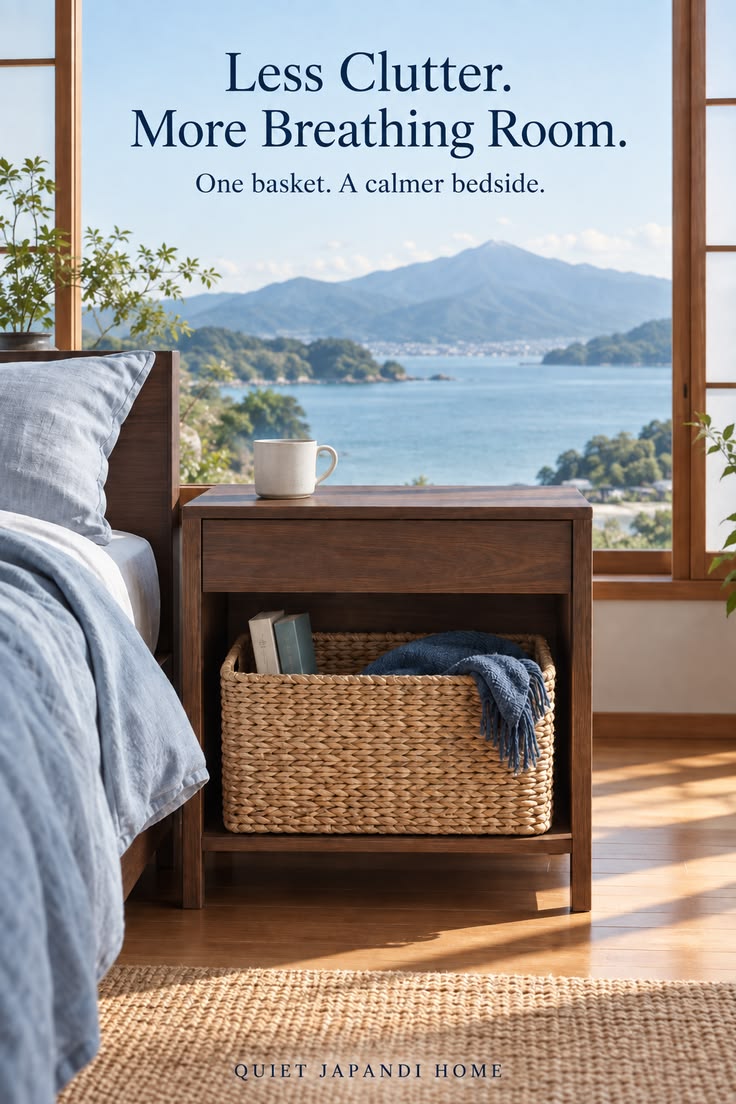
Visible storage is the enemy of a small Japandi bedroom. Use the space under the bed with flat lidded boxes, choose a nightstand with a drawer instead of an open shelf and keep a single closed cabinet rather than open shelving. Everything that stays out should be something you chose to look at.
A slim wall hook or a wooden peg rail can hold tomorrow’s clothes so they do not land on a chair.
The nightstand can disappear too. A wall-mounted floating nightstand about 16 inches wide and 13 inches deep (40 x 33 cm) holds the lamp and one book on top and hides the charger in a closed drawer, while the floor underneath stays bare and the room reads wider. Mount it level with the top of the mattress or an inch or two above, and run the lamp cable through the cord hole so it does not hang down the wall. Screw it into a stud if you can; if you rent, ask before drilling. Keep it light, too: the one we link is rated for 33 lb (15 kg) on top and 11 lb (5 kg) in the drawer.
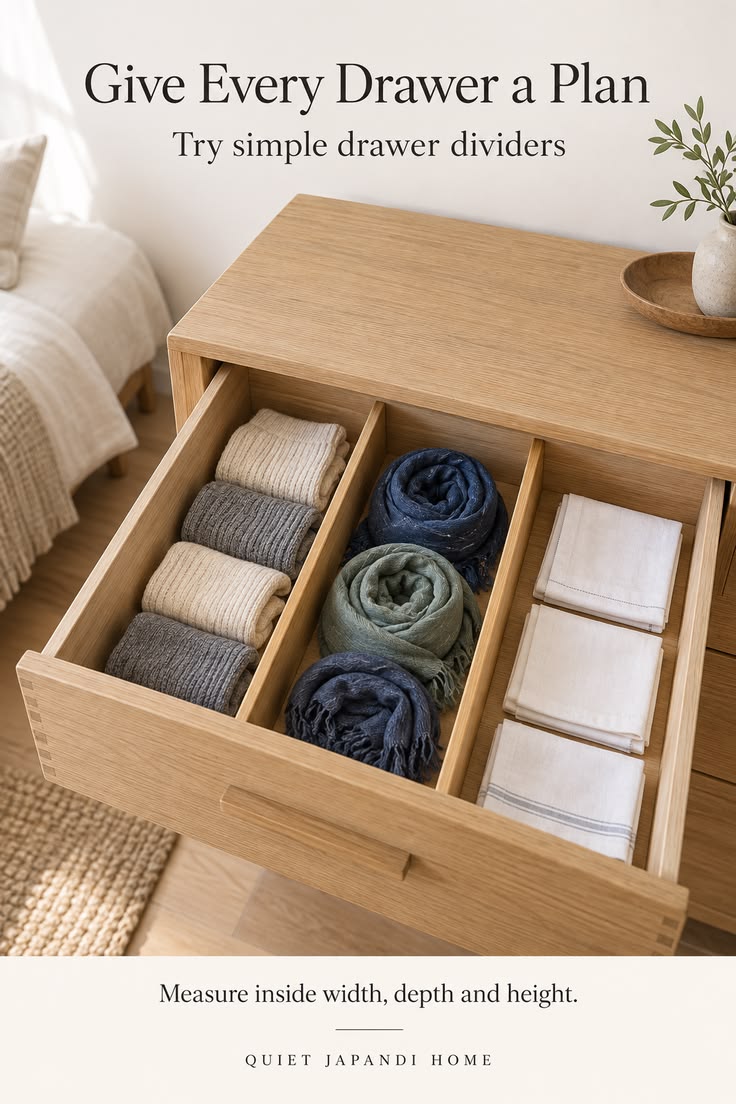
Inside the dresser, fold clothes into small upright rectangles and stand them on edge, front to back, instead of stacking them. This is often called file folding: every T-shirt shows at a glance, and taking one out does not topple the pile. Soft fabric bins in two or three sizes keep each category together and stop the rows from sliding over as the drawer empties.
Idea 6: One rug, slightly larger than you think
A rug that stops at the foot of the bed makes the room look chopped up. Choose a flat-weave wool or jute rug large enough to extend at least 18 inches (45 cm) beyond the sides of the bed, so your feet land on it in the morning. A single large rug unifies the floor and makes the room feel wider.
Keep the rug in a natural undyed tone. Pattern, if any, should be a subtle weave texture rather than a print.
What size is that in practice? For a queen bed (60 inches wide) or a full (54 inches), a 6 by 9 foot rug (about 180 x 270 cm) laid sideways, with the long side across the room, usually works: slide it under the lower two-thirds of the bed so the nightstands stay off it, and it reaches about 2 feet (60 cm) past each side and about a foot and a half past the foot. Mark the outline with painter’s tape before you buy to check the doors still swing over it. A natural jute weave suits the low wood bed; if bare feet matter more, look for a softer wool or cotton blend.
Idea 7: Give one object all the attention
Japandi rooms feel considered because there is one point of focus, not many. In a small bedroom that might be a single branch in a ceramic vase on the nightstand, one framed ink drawing above the bed or a small wooden stool in the corner holding a book. Choose one, then resist adding more.
If your one object is art above the bed, a single cherry blossom print suits the room well. Choose one branch drawn with plenty of bare paper around it, in soft pink, grey or ink black, rather than a full scene with mountains and temples. Put it in a thin light oak frame with a wide white mat: the mat adds breathing room, and the oak repeats the bed so the print looks like part of the room. An 18 x 24 inch (46 x 61 cm) frame hung horizontally fills the wall above a full or queen bed without crowding it. Center it on the bed and leave about 8 to 10 inches (20 to 25 cm) between the headboard or mattress top and the bottom of the frame.
Hang it so it stays put. Over a bed, skip adhesive strips: the maker of the best-known damage-free strips says not to use them above a bed. Use two nail-in picture hooks instead, each rated well above the frame’s weight, set level and spaced apart so the frame cannot tip. Slim brass hooks rated for 20 lb (9 kg) each leave only small pin holes, which matters if you rent. Choose a frame with acrylic rather than glass if you can, check the wall for pipes and cables before you hammer, and give the frame a tug before you sleep under it.
When something new comes in, something else goes out. That rule keeps the room calm months after you finish styling it.
How to Get the Look
- Lower the bed first. Remove the headboard or switch to a platform frame.
- Paint or leave the walls a warm off-white; avoid bright white and cool grey.
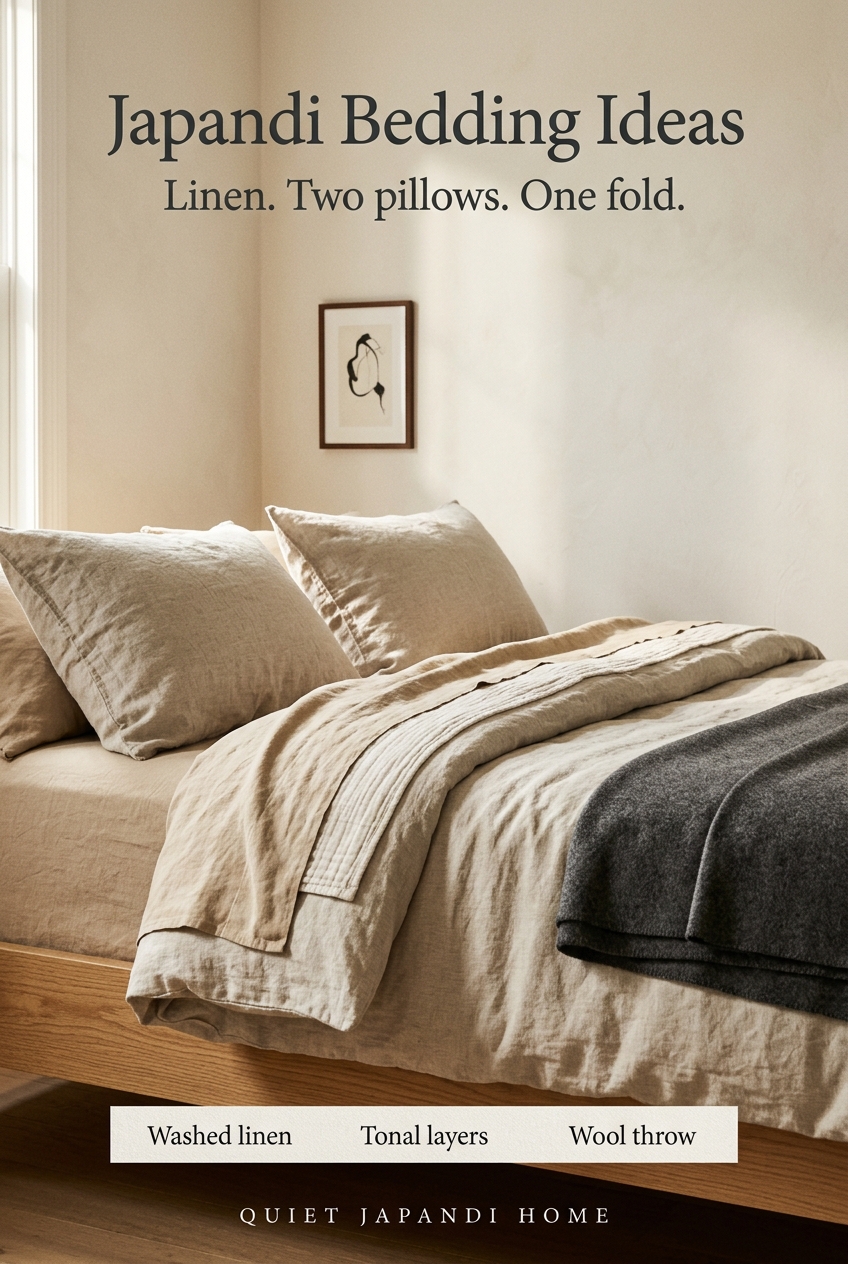
- Dress the bed in washed linen: one duvet, two pillows, one folded throw in a deeper neutral.
- Add a wood nightstand in a light tone with a drawer, or a floating shelf.
- Replace the ceiling fixture with a paper pendant and add a small warm lamp or sconce.
- Put down one large natural rug and clear everything else off the floor.
- Choose one object for the nightstand and one for the wall. Stop there.
Recommended Items
A few pieces that carry this look. Each link opens Amazon in a new tab, so you can compare sizes, colors and reviews.
Low Floor Platform Bed Frame in Pine, Queen, No Headboard
Why it works: The frame is 7.7 inches tall and rests on the floor, with no headboard or footboard, so the bed sits close to the ground and the ceiling feels higher. It is engineered wood in a pine tone, not solid oak.
View on AmazonOatmeal Linen Duvet Cover Set
Why it works: Washed linen adds the soft, slightly rumpled texture Japandi rooms rely on, without adding pattern or color.
View on Amazon19-Inch Rice Paper Orb Pendant with Bamboo Ribs
Why it works: A round rice paper shade on uneven bamboo ribs spreads warm, even light, comes with its own socket set and plugs in, so a renter can hang it from a hook beside the bed without rewiring.
View on AmazonWall-Mounted Floating Nightstand in Light Oak, with Drawer
Why it works: About 16 inches wide and 13 deep, with a closed drawer, an open cubby and a cord hole; it holds the lamp and a book while the floor beneath stays bare, which is the single biggest trick for a small room.
View on AmazonAdjustable Bamboo Drawer Dividers
Why it works: Gives socks, scarves and small linens a fixed place, so the drawer stays tidy after you close it and nothing ends up on top of the dresser.
View on AmazonFabric Drawer Organizer Bins, Set of 12 in 3 Sizes
Why it works: Soft beige bins in three sizes hold file-folded T-shirts, underwear and socks upright, so each row stays standing as the drawer empties.
View on AmazonNatural White Oak Poster Frame, 18x24 with Mat for 16x20
Why it works: A thin solid oak frame repeats the light wood of the bed, and the wide mat gives a single sakura print the empty space around it that Japandi art relies on.
View on AmazonProfessional Picture Hangers, Brass, 20 lb, 15 Sets
Why it works: Nail-in brass hooks rated for 20 lb each that leave only small pin holes; use two to hang a framed print securely and level above the bed, where adhesive strips should not be used.
View on AmazonBraided Jute Area Rug, 6 x 9 Feet, Natural
Why it works: A handwoven, reversible jute rug in an undyed tone; at 6 by 9 feet laid sideways it reaches past both sides of a full or queen bed, so your feet land on it in the morning.
View on AmazonSolid Walnut Tray, 11.8 x 5 Inches
Why it works: A small tray of North American walnut with an oiled finish; on a light oak nightstand it holds a watch, glasses and phone overnight and becomes the one deliberate dark wood in the room.
View on AmazonAs an Amazon Associate, Quiet Japandi Home earns from qualifying purchases. This does not change the price you pay. Read our disclosure.
FAQ
What bed size works in a small Japandi bedroom?
A full or queen platform bed usually fits if you keep at least 24 inches (60 cm) of walkway on one side. Choose a frame without a tall headboard and without a footboard so the bed reads as one low shape.
Can a small Japandi bedroom have color?
Yes, in small doses. Keep walls and bedding in warm neutrals, then add one muted color such as sage, clay or charcoal in a single item: a throw, a cushion or a piece of art.
What size art goes above a full or queen bed?
For a single print, an 18 x 24 inch (46 x 61 cm) frame hung horizontally fills the wall above a full or queen bed without crowding it. Center it on the bed and leave about 8 to 10 inches (20 to 25 cm) between the headboard or mattress top and the bottom of the frame.
How do I keep a small bedroom from feeling empty and cold?
Use texture instead of objects: linen bedding, a wool or jute rug, a wood nightstand and warm light at 2700K. Two or three textures do more for coziness than ten decorations.